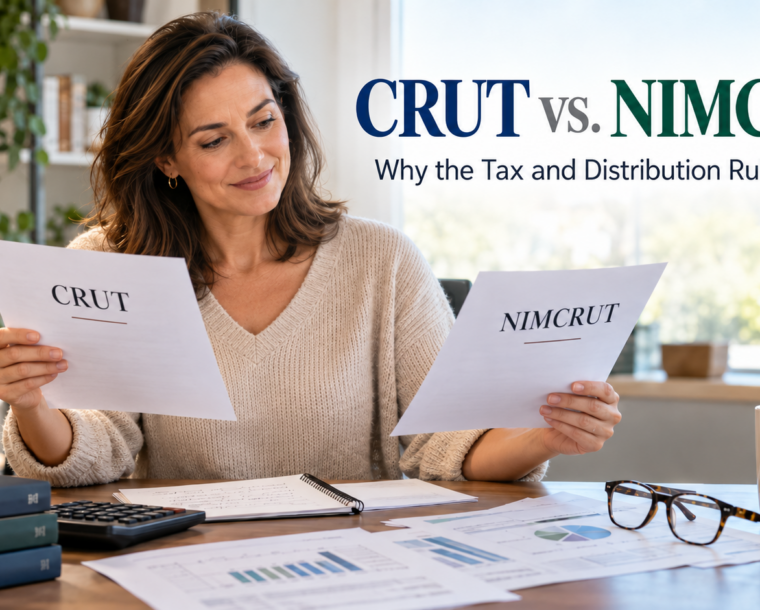
Understanding how charitable remainder trusts affect your cash flow, income taxes, and long-term financial planning.
Key takeaway:
Choosing between a standard charitable remainder unitrust (CRUT) and a net income with makeup charitable remainder unitrust (NIMCRUT) can affect how much income you receive, when you receive it, and how your distributions are taxed.
If you own highly appreciated assets, a charitable remainder trust (CRT) may offer opportunities to generate income, defer certain tax consequences, and support charitable causes. These trusts are irrevocable, and remaining assets ultimately pass to charity.
CRUT vs. NIMCRUT: What Is the Difference?
A standard CRUT generally pays a fixed percentage of its annually determined value. A NIMCRUT is a type of CRUT that generally pays the lesser of its annual unitrust amount or fiduciary accounting income. Shortfalls are tracked for possible makeup distributions, but recovery is not guaranteed.
| Feature | Standard CRUT | NIMCRUT |
| Annual payment | Percentage of trust value | Limited by accounting income |
| Cash flow | More predictable formula | May vary with accounting income |
| Makeup provision | No | Yes |
| Administration | Generally simpler | Requires makeup tracking |
Why Should You Care?
The trust you choose can affect retirement income, cash-flow flexibility, and future tax obligations. A standard CRUT may suit someone who needs payments based on trust value. A NIMCRUT may be appropriate for someone who can tolerate lower payments in certain years.
CRT distributions are not necessarily tax-free. Under Internal Revenue Code Section 664, payments generally carry out ordinary income first, then capital gains, other income (including tax-exempt income), and finally principal. Income and gains accumulated in prior years can affect the tax treatment of later payments.
What Does This Mean for You?
Assume a $2 million annual trust valuation, a 5% payout rate, a full year, and no opening makeup balance. A standard CRUT would generally distribute $100,000. If a NIMCRUT has only $40,000 of fiduciary accounting income, it generally pays $40,000 and tracks a $60,000 shortfall. A later makeup payment is possible only when accounting income exceeds that later year’s unitrust amount, and only up to the accumulated shortfall.
If you rely on trust payments for living expenses, the difference can be significant. Accounting income used to calculate a NIMCRUT payment is not necessarily the same as taxable income used to determine the payment’s tax character.
What Should You Do Next?
Choosing the right charitable remainder trust is about more than tax benefits. It is about making sure the trust supports your income needs, financial goals, and long-term charitable intentions.
Before establishing a CRUT or NIMCRUT, consider how much income you will need, whether you can manage fluctuations in distributions, and how those payments may affect your future taxes.
Timing is especially important if you plan to contribute appreciated assets before a sale. A properly structured CRT may defer certain capital gains taxes rather than eliminate them; later distributions may carry taxable income or gains. Have tax and legal advisors review the transaction before making sale commitments.
If you already have a CRT, periodic reviews can help identify potential distribution, tax-planning, and reporting issues.
At Greenwood Ohlund, we help clients evaluate the tax implications of charitable remainder trusts, including distribution planning, appreciated asset transactions, and ongoing tax obligations. Whether you are considering a new trust or reviewing an existing one, understanding these issues early can help you avoid unexpected tax and cash-flow consequences.
Considering a charitable remainder trust or planning to transfer appreciated assets? Contact Greenwood Ohlund to discuss the tax considerations before making your next decision.
Frequently Asked Questions
Does a standard CRUT pay the same dollar amount each year?
No. Its fixed percentage is applied to the trust’s annually determined value, so the dollar payment can increase or decrease.
Is trust accounting income the same as taxable income?
No. Accounting income is determined under the trust document and applicable law, while taxable income is determined under tax rules. This distinction affects how NIMCRUT distributions are calculated and taxed.
Are NIMCRUT makeup payments guaranteed?
No. Makeup payments depend on future accounting income exceeding the current year’s unitrust amount and are limited by the accumulated shortfall.
References
IRS — Charitable Remainder Trusts
IRS — Instructions for Form 5227
Diem Bui, CPA, EA, MBA | Tax Manager
This article is for general informational purposes only and does not constitute tax or legal advice. Consult your tax and legal advisors regarding your specific situation.