A practical look at how AI can make outsourced accounting faster, more insightful, and more valuable to management
Artificial intelligence is changing the accounting profession, but the biggest opportunity is not simply automating bookkeeping.
The greater opportunity is combining AI with outsourced accounting professionals to produce faster financial information, stronger analysis, better documentation, and more useful insight for management.
For small and midsized businesses and nonprofit organizations, outsourced accounting already provides access to a broader finance function than many organizations can reasonably build internally. When AI is incorporated thoughtfully into that model, the accounting team can spend less time compiling information and more time understanding it, validating it, and helping leadership make better decisions.
What Is AI-Enabled Outsourced Accounting?
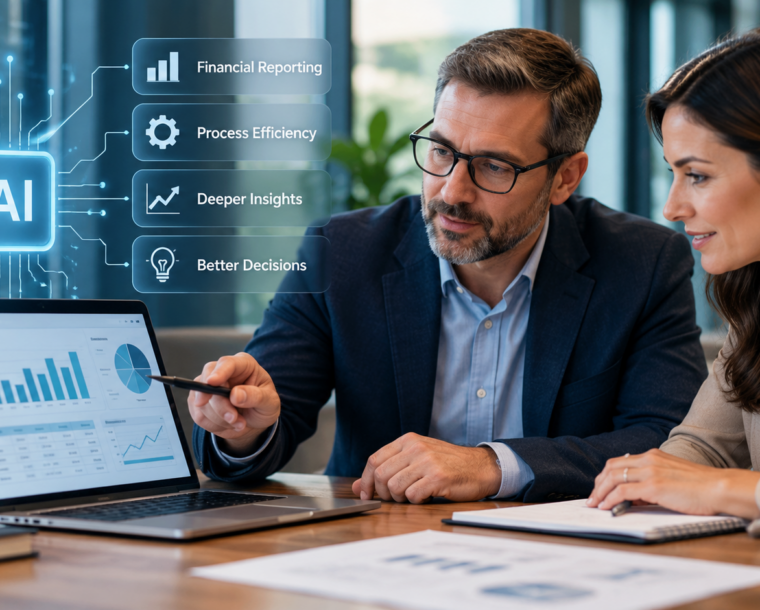
AI-enabled outsourced accounting combines experienced accounting professionals with artificial intelligence and automation tools to improve financial reporting, analysis, documentation, forecasting, and accounting processes.
AI can help accounting teams process and organize large amounts of information quickly. The outsourced accounting team then applies professional judgment, institutional knowledge, accounting standards, and an understanding of the organization to determine what that information actually means.
That distinction matters.
AI should not replace the accountant. It should make a good accountant more effective.
How Can AI Improve Outsourced Accounting Services?
AI can improve outsourced accounting services by reducing the amount of time professionals spend gathering, organizing, summarizing, and manipulating financial information.
- Analyzing financial statement variances
- Summarizing accounting procedures and workflows
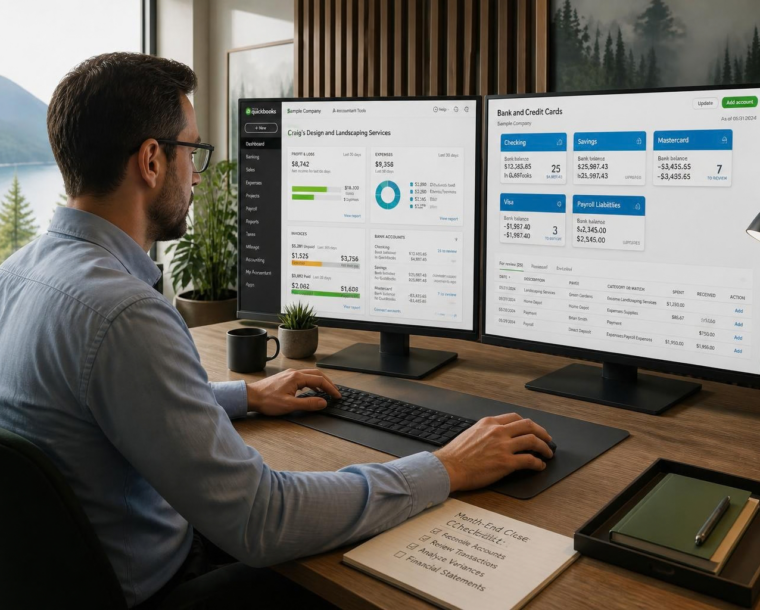
- Assisting with month-end close processes
- Identifying unusual transactions or trends
- Creating first drafts of financial narratives
- Developing management reporting
- Organizing meeting transcripts and process documentation
- Supporting cash flow forecasting
- Building financial scenarios
- Analyzing large accounting datasets
- Developing accounting policies and procedures
- Preparing information for management and Boards
These efficiencies can fundamentally change how an outsourced accounting team allocates its time. Instead of spending the majority of its time assembling information, the team can spend more time evaluating whether the information is accurate and helping management understand its significance.
A Real-World Example: Using AI During an Accounting Department Transition
One recent example illustrates where the combination of AI and experienced accounting professionals can create substantial value.
During an accounting department transition, our team needed to understand how the organization’s existing accounting function actually worked.
We spent approximately four hours meeting directly with members of the accounting department, walking through their responsibilities, accounting systems, workflows, month-end close process, financial reporting procedures, internal controls, and operational challenges.
Those conversations were important. Rather than beginning with a checklist and making assumptions about how the organization operated, we were able to talk directly with the people performing the work.
The meetings provided detailed information about topics such as:
- Who performs each accounting function
- How accounts payable is processed
- How cash receipts are recorded
- How payroll information enters the accounting system
- How bank and balance sheet accounts are reconciled
- How the monthly close is performed
- Where spreadsheets or manual processes are being used
- How financial reports are prepared
- How management receives financial information
- Where internal controls exist
- Where processes are dependent on a single employee
- Where opportunities exist to improve efficiency or reduce risk
Historically, the next step would have required substantial additional time. Someone would need to review handwritten notes, revisit individual conversations, organize several hours of information, identify common themes, document processes, and then put pen to paper to create a coherent summary for management.
Instead, we were able to work from the meeting transcripts and use AI to help coalesce several hours of detailed conversations into a cohesive initial executive summary.
That did not mean simply accepting an AI-generated report. It changed where we spent our professional time.
Instead of spending hours manually converting notes into paragraphs, we could focus on reviewing the narrative, validating it against what we learned during the meetings, identifying gaps, challenging assumptions, and making sure the final document accurately mapped to what the organization had actually implemented.
AI saved time on composition. Our professionals spent that time on judgment.
The result was a more efficient process and, more importantly, a better management deliverable.
Why Is This a Better Use of an Accountant’s Time?
Accounting professionals create the greatest value when they are applying judgment rather than performing administrative work.
Consider the accounting department transition example. The value was not in physically typing four hours of conversations into a report. The value came from:
- Asking the right questions
- Understanding the organization’s accounting environment
- Recognizing control weaknesses
- Identifying inefficient processes
- Comparing practices with accounting best practices
- Determining which issues were actually significant
- Validating that documented procedures reflected reality
- Translating accounting observations into recommendations management could act upon
AI accelerated the mechanical portion of the process. The accounting professionals remained responsible for the thinking. This is one of the clearest examples of how AI can improve professional services without eliminating the professional.
Faster Financial Reporting Can Lead to Better Decisions
One of the most common reasons organizations seek outsourced accounting services is delayed financial reporting. Management may be receiving financial statements weeks, or even months, after the reporting period has ended. At that point, management is often looking backward rather than making decisions based on current information.
AI can help accounting teams accelerate portions of the monthly close and financial reporting process by assisting with account analysis, variance identification, research, documentation, and preparation of management commentary.
Combined with disciplined accounting procedures, these efficiencies can help organizations receive useful financial information sooner.
Timely financial reporting allows management to answer important questions such as:
- Are revenues tracking according to budget?
- Are payroll costs increasing faster than expected?
- Is cash flow tightening?
- Are gross margins changing?
- Which departments or programs are driving financial results?
- Are operating expenses trending higher?
- Are receivables taking longer to collect?
- Does management need to revise its annual forecast?
The sooner leadership understands what is happening, the more time it has to respond.
How Can AI Make Financial Statements More Useful?
Financial statements tell management what happened. A strong outsourced accounting team should also help explain why it happened and what management should be paying attention to next.
AI can assist accounting professionals in quickly analyzing:
- Month-over-month changes
- Year-over-year trends
- Budget-to-actual variances
- Departmental performance
- Revenue concentration
- Expense trends
- Gross margin changes
- Cash flow movements
- Working capital
- Key performance indicators
For example, an income statement might show that operating expenses increased by 12%. That number alone is not particularly useful.
The more valuable questions are:
- Which accounts caused the increase?
- Which departments incurred the additional costs?
- Is the increase recurring?
- Was the increase planned?
- Is it consistent with the budget?
- Does it change the organization’s forecast?
- Does management need to take action?
AI can help accelerate the analysis. The outsourced accounting professional provides the context.
AI Can Improve Financial Forecasting and Scenario Planning
Annual budgets are important, but businesses rarely operate exactly according to budget. Revenue changes. Employees are hired. Customers delay payments. Projects move. Vendor costs increase. New opportunities arise.
Organizations therefore need the ability to update their financial outlook throughout the year. AI can help outsourced CFO and accounting teams model financial scenarios more efficiently.
Management may want to understand:
- What happens if revenue declines by 10%?
- Can we afford to hire additional employees?
- How much cash will we have six months from now?
- What happens if our largest customer leaves?
- What revenue level is required to reach our target operating margin?
- When might we need to access our line of credit?
- What happens if payroll costs increase faster than revenue?
Historically, answering these questions could require significant spreadsheet manipulation and manual analysis. AI can reduce some of that preparation time, allowing the outsourced CFO to focus more heavily on evaluating assumptions and discussing the implications with management.
A financial model is only as useful as the assumptions behind it. That is why human financial judgment remains essential.
How Does Outsourced Accounting Help Small and Midsized Organizations?
A major advantage of outsourced accounting is access to professionals with experience across multiple organizations, industries, accounting systems, and business situations.
Instead of relying on a single internal employee to perform every accounting function, an outsourced model can provide access to different levels of expertise. Depending on the organization, that may include:
- Transactional accounting support
- Senior accounting oversight
- Controller-level financial reporting
- Outsourced CFO services
- Budgeting and forecasting
- Internal control review
- Audit preparation
- Board and Finance Committee reporting
- Accounting system implementation
- Financial dashboard development
AI can amplify this model by allowing those professionals to spend more time on higher-level financial management.
AI Can Help Turn Financial Data Into Management Information
Most organizations do not lack data. They lack useful information.
A business may have information spread across accounting software, payroll systems, banking platforms, credit cards, customer relationship management systems, inventory systems, point-of-sale platforms, operational databases, and Excel spreadsheets.
Management does not necessarily need more reports. It needs better answers.
A modern outsourced accounting function should help connect financial information to business operations so leadership can understand what is changing and why. AI can help analyze and organize that information much faster than traditional manual methods.
What Role Should Human Judgment Play in AI Accounting?
Human judgment should remain central to accounting. AI can assist with analysis and preparation, but it does not eliminate the need for:
- Professional skepticism
- Accounting expertise
- Internal controls
- Management approval
- Data validation
- Confidentiality
- Segregation of duties
- Review procedures
- Understanding of organizational context
AI systems can misunderstand information, rely on incomplete data, or generate inaccurate conclusions. For that reason, financial information produced with AI assistance should still be reviewed by qualified professionals.
The goal is not AI instead of accountants. The stronger model is AI plus accountants.
Does AI Replace Internal Controls?
No. AI should not replace internal controls, professional review, or appropriate approval processes.
Organizations should understand:
- Which AI tools are being used
- What information is being entered into those systems
- Whether confidential financial information is protected
- Who reviews AI-generated analysis
- Who approves financial transactions
- How exceptions are investigated
- How financial information is validated
Technology should strengthen the accounting environment, not create additional risk.
What Should You Expect From a Modern Outsourced Accounting Provider?
A modern outsourced accounting provider should deliver more than accurate bookkeeping. The accounting function should help management understand the financial condition of the organization.
Organizations should increasingly expect:
- Timely monthly financial statements
- Accurate accounting records
- Reliable month-end closing procedures
- Strong internal controls
- Cash flow forecasting
- Budget-to-actual reporting
- Financial dashboards and KPIs
- Scenario modeling
- Management reporting
- Board and Finance Committee reporting
- Accounting process improvement
- Thoughtful use of automation and AI
- Strategic financial guidance
The technology will continue changing. The objective should remain consistent: provide management with accurate, timely, and useful financial information that supports better decision-making.
Frequently Asked Questions About AI and Outsourced Accounting
Can AI replace an outsourced accountant?
AI can automate or accelerate certain accounting activities, but it does not replace the need for professional judgment, financial oversight, internal controls, and an understanding of an organization’s operations. The strongest model combines AI capabilities with experienced accounting professionals.
How is AI being used in accounting?
AI is increasingly being used to analyze transactions, identify financial trends, summarize information, assist with reconciliations, develop management commentary, document procedures, analyze variances, and support financial forecasting.
Can AI make the monthly accounting close faster?
AI can help accelerate portions of the monthly close by assisting with data analysis, identifying anomalies, researching account activity, organizing documentation, and preparing preliminary financial analysis. A fast close, however, still depends on disciplined accounting procedures and consistent underlying processes.
Is outsourced accounting only bookkeeping?
No. Outsourced accounting can range from transactional bookkeeping through controller and CFO-level financial management. A sophisticated outsourced accounting model may include financial reporting, forecasting, dashboards, internal controls, strategic planning, audit support, and reporting to Boards or other governance bodies.
How can AI help management make better financial decisions?
AI can help accounting teams analyze larger amounts of information more quickly, identify trends, create financial scenarios, and summarize complex information. Accounting professionals can then interpret those results and help management determine what actions may be appropriate.
The Competitive Advantage Is the Combination of People and Technology
There is a tendency to frame artificial intelligence as a replacement for traditional accounting. That misses the larger opportunity.
AI is particularly powerful when it eliminates low-value administrative effort and creates additional capacity for people to perform high-value work.
In our accounting department transition example, the objective was not to eliminate the four hours of conversations. Those four hours may have been the most important part of the entire process.
We wanted to spend time listening to the accounting team, asking follow-up questions, understanding the processes, and learning how the organization actually operated. What we wanted to reduce was the administrative work that came afterward.
AI allowed us to spend less time transcribing and drafting and more time validating, discussing, challenging, and refining.
Use technology to make the mechanical work more efficient so professionals have more time to think.
Helping Your Business Flourish
The best accounting departments often operate quietly in the background. Transactions are processed correctly. Accounts are reconciled. Financial statements arrive on time. Management understands cash flow. Leadership knows where the organization stands. There are fewer financial surprises.
That consistency creates the foundation for better business decisions.
Outsourced accounting supported by AI can take that foundation further by making financial information faster to produce, easier to analyze, more thoroughly documented, and more useful to management.
The real promise of AI in accounting is not simply doing accounting work faster.
It is creating more capacity for accounting professionals to understand the business, work directly with management, evaluate financial risk, improve processes, and help leadership make informed decisions.
That is how outsourced accounting and AI can work together to help a business flourish.
Jason Mallon, CAS Partner